-
Advent
 Advent Reconciliation Services
Sacred Heart- Monday, December 15th at 7:00 p.m.The Advent season is a time of preparation that directs our hearts and minds to Christ’s second coming at the end of time and to the anniversary of Our Lord’s birth on Christmas. From the earliest days of the Church, people have been fascinated by Jesus’ promise to come back. But the scripture readings during Advent tell us not to waste our time with predictions. Advent is not about speculation. Our Advent readings call us to be alert and ready, not weighted down and distracted by the cares of this world (Lk 21:34-36). Like Lent, the liturgical color for Advent is purple since both are seasons that prepare us for great feast days. Advent also includes an element of penance in the sense of preparing, quieting, and disciplining our hearts for the full joy of Christmas.
As we prepare for Christmas, the General Instruction of the Roman Missal notes some differences to the Mass that should be observed during the season. For instance, the priest wears violet or purple during Advent, except for the Third Sunday of Advent (Gaudete Sunday) when rose may be worn (GIRM, no. 346). Aside from what the priest wears, other aesthetic changes in the Church can include a more modestly decorated altar.
The final days of Advent, from December 17 to December 24, we focus on our preparation for the celebrations of the Nativity of our Lord at Christmas. In particular, the "O" Antiphons are sung during this period and have been by the Church since at least the eighth century. They are a magnificent theology that uses ancient biblical imagery drawn from the messianic hopes of the Old Testament to proclaim the coming of Christ as the fulfillment not only of Old Testament hopes, but of present ones as well.
Advent devotions including the Advent wreath, remind us of the meaning of the season. Our Advent calendar (linked below) can help you fully enter into the season with daily activity and prayer suggestions to prepare you spiritually for the birth of Jesus Christ.
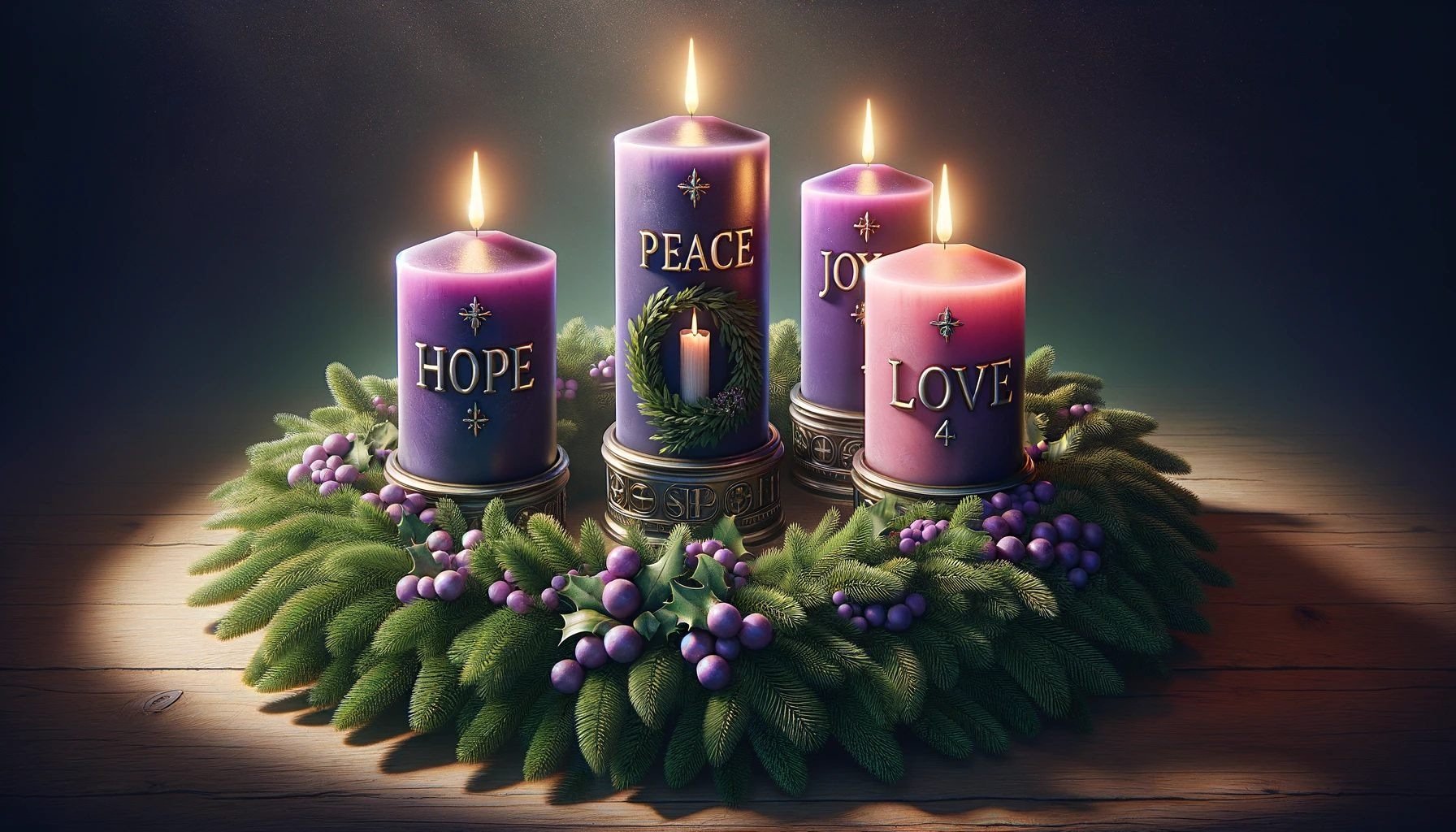
Traditionally, Advent wreaths are constructed of a circle of evergreen branches into which four candles are inserted, representing the four weeks of Advent. Ideally, three candles are purple, and one is rose, but white candles can also be used.
The purple candles symbolize the prayer, penance, and preparatory sacrifices and goods works undertaken at this time. The rose candle is lit on the third Sunday, Gaudete Sunday, when the priest also wears rose vestments at Mass; Gaudete Sunday is the Sunday of rejoicing, because the faithful have arrived at the midpoint of Advent, when their preparation is now half over, and they are close to Christmas.
The progressive lighting of the candles symbolizes the expectation and hope surrounding our Lord’s first coming into the world and the anticipation of his second coming to judge the living and the dead.
The use of the Advent Wreath is a traditional practice which has found its place in the Church as well as in the home. The blessing of an Advent Wreath takes place on the First Sunday of Advent or on the evening before the First Sunday of Advent.
When the blessing of the Advent Wreath is celebrated in the home, it is appropriate that it be blessed by a parent or another member of the family.
All make the Sign of the Cross as the leader says:
Our help is in the name of the Lord.
Response (R/.) Who made heaven and earth.Then the Scripture, Isaiah 9: (lines 1-2 and 5-6) or Isaiah 63 (lines 16-17 & 19) or Isaiah 64 (lines 2-7) is read:
Reader: The word of the Lord.
R/. Thanks be to God.With hands joined, the leader says:
Lord our God,
we praise you for your Son, Jesus Christ:
he is Emmanuel, the hope of the peoples,
he is the wisdom that teaches and guides us,
he is the Savior of every nation.Lord God,
let your blessing come upon us
as we light the candles of this wreath.
May the wreath and its light
be a sign of Christ’s promise to bring us salvation.
May he come quickly and not delay.
We ask this through Christ our Lord.
R/. Amen.The blessing may conclude with a verse from
“O Come, O Come, Emmanuel”:O come, desire of nations, bind
in one the hearts of humankind;
bid ev’ry sad division cease
and be thyself our Prince of peace.
Rejoice! Rejoice! Emmanuel
shall come to thee, O Israel.